Hunyuan Video is Tencent’s open-source AI video model — a 13B-parameter system launched in December 2024 that turns text (and later images) into HD clips with surprisingly cinematic motion.
I spent time testing it for prompt following, visual consistency, and real production usefulness. Below is my honest review: what it does well, where it still struggles, and the simplest way to try it without a local GPU farm.
Quick Verdict
Hunyuan Video is one of the most important open-source video models available today. For creators who want cinematic text-to-video without locking into a single closed platform, it is worth serious attention.
It handles simple, atmospheric prompts well and keeps motion relatively smooth at native 720p. Complex multi-object scenes need more iteration, and local installs demand serious VRAM. For most creators, a hosted workspace like Van Gogh Studio is the practical path.
| Feature | Hunyuan Video |
|---|---|
| Best at | Cinematic text-to-video, natural motion, open-source experimentation |
| Weakest at | Complex multi-subject scenes, native audio/lip-sync workflows |
| Native resolution | Around 1280×720 |
| Model scale | ~13B parameters |
| Local hardware | High VRAM (often cited around 40GB+ class setups for comfortable runs) |
| Best for | Creators, researchers, and teams who want open weights plus a fast hosted path |
What Is Hunyuan Video?
Hunyuan Video is an AI video generation model from Tencent, the Shenzhen-based technology company behind WeChat and a growing AI stack under the Hunyuan name.
According to Tencent’s December 2024 announcement, Hunyuan Video was released as a large open-source video model. Its text pathway uses a decoder-only multimodal LLM, and a 3D VAE helps compress and reconstruct video with better temporal consistency across frames. Official materials and the GitHub repo are the best sources for architecture details and weights.
In practice, that means:
- Stronger language understanding than older text-to-video stacks that treated prompts as loose keywords
- Smoother frame-to-frame motion for landscape, lifestyle, and atmospheric shots
- An open-source path for researchers and builders who want to self-host or fine-tune
Tencent has also pushed image-to-video and higher-resolution directions after the initial launch. Availability and quality can differ between local installs, community frontends, and hosted platforms — so evaluate the path you actually plan to use.
What Stood Out in My Tests
Strong cinematic look on simple prompts
With short, clear prompts — mood, subject, and camera — Hunyuan often landed a polished look on the first or second try. Lighting felt natural, transitions were relatively smooth, and outputs looked closer to “short film B-roll” than toy demos.
Example style of prompt that worked well:
Slow push-in on a rainy Tokyo alley at night, neon reflections on wet pavement, shallow depth of field, cinematic color grade.
Prompt rewrite / semantic boost helps
Hunyuan’s prompt-enhancement behavior is useful when your description is thin. It can fill in lighting, framing, and atmosphere so a sparse idea still produces a watchable clip. That is helpful for speed — but keep an eye on it when you need exact brand or product control.
Open source still matters
Even with stronger closed models shipping every month, open weights change the economics. Teams can inspect, adapt, and deploy without waiting on a vendor waitlist. For research, custom pipelines, and long-term cost control, that remains a real advantage.
Where Hunyuan Fell Short
Complex scenes need retries
When prompts stacked many constraints — multiple people, specific actions, and conflicting moods — adherence dropped. One of my harder prompts was roughly:
Person watching life rush by from a café window. Intimate, introspective. City blur outside, cozy warm light inside.
The model sometimes lost the emotional framing or mixed interior/exterior cues. Usable results usually came after simplifying the brief or splitting the idea into clearer shots.
Local installs are heavy
Self-hosting Hunyuan is not a laptop hobby for most people. Community setups commonly point to high VRAM requirements; undersized GPUs mean slow generations or lower quality. If you mainly want finished clips, hosted access is usually the better first step.
Limited production controls
Out of the box, Hunyuan is not a full editor. Frame-by-frame polish, reliable lip-sync, and rich native audio workflows are still weaker than some closed production suites. Plan to finish audio, pacing, and brand polish in a separate tool — or use a platform that wraps the model with those extras.
Pros and Cons
Pros
- Open-source 13B video model with strong community interest
- Solid cinematic quality on clear, atmospheric prompts
- Smooth motion and usable 720p native output for many social/web uses
- Useful semantic understanding and prompt enhancement
- Flexible path: local research stacks or hosted generation
Cons
- Complex multi-object prompts need more iteration
- Local hardware barrier is high
- Advanced editing, audio, and lip-sync are not its core strength
- Quality and feature set vary by frontend / host
How to Try Hunyuan Without Fighting Local Setup
You can install Hunyuan locally from the official open-source releases — but for day-to-day creative work, I prefer Van Gogh Studio.
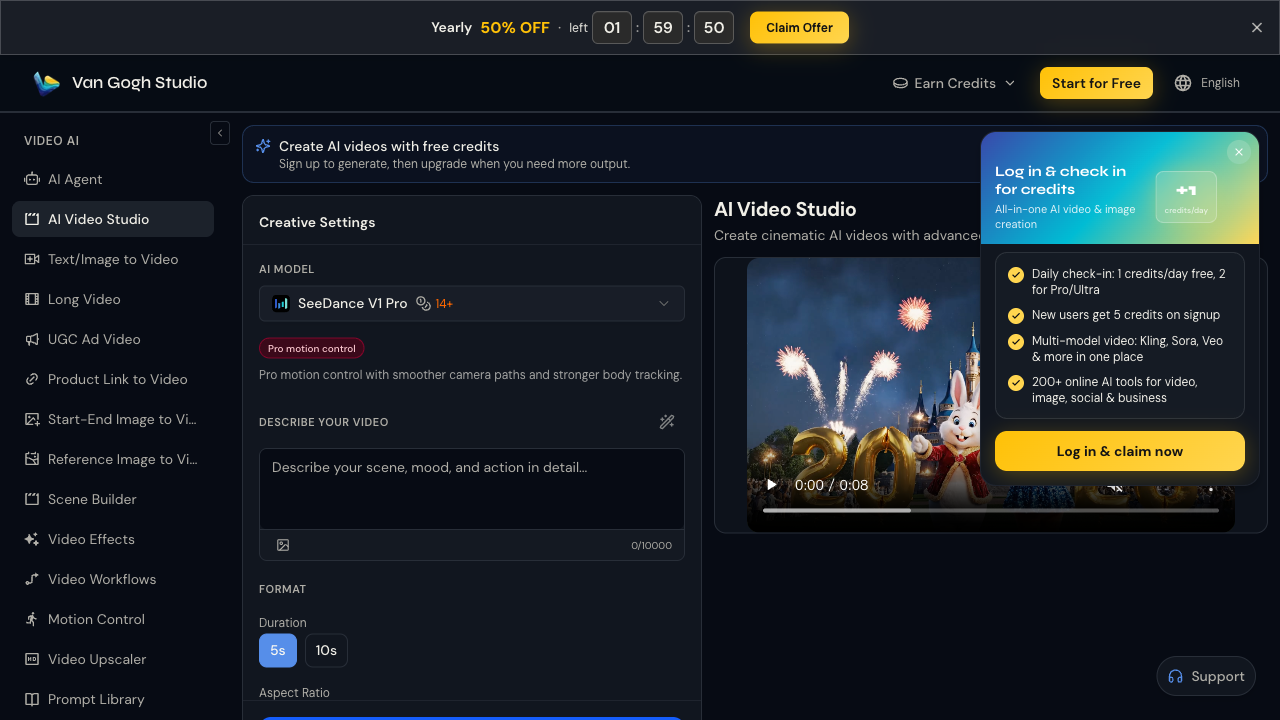
Van Gogh Studio puts multiple leading video models in one workspace, so you can generate with Hunyuan-class open models alongside options like Kling AI, Runway, and Luma AI without juggling separate accounts.
Practical workflow I recommend:
- Open AI Video Studio or image to video
- Describe the scene clearly: subject, action, camera, lighting, mood
- Start with a simple shot, then iterate instead of packing every detail into one prompt
- Compare outputs against another model when the brief is commercial or brand-critical
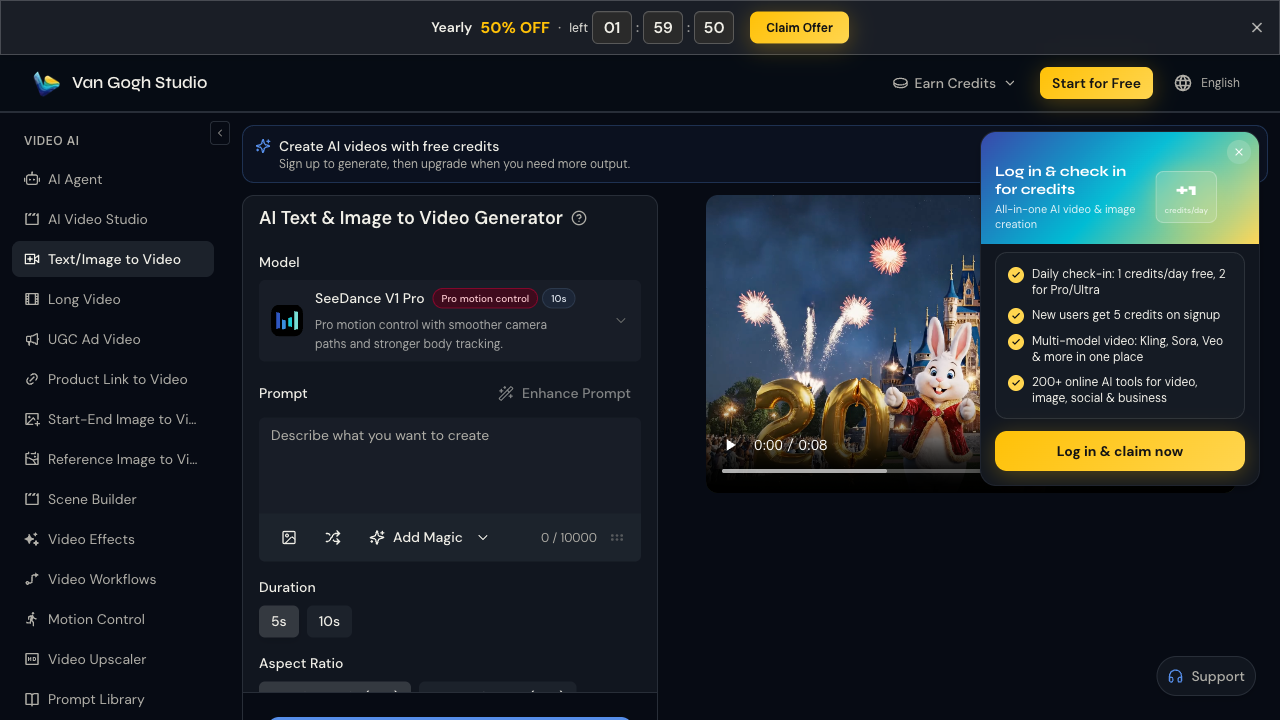
Beyond raw generation, Van Gogh Studio also covers common finishing needs — text to video, restyling, extending clips, and other AI tools — so you are not stuck exporting a silent draft and rebuilding the whole pipeline elsewhere.
Final Verdict
Hunyuan AI is not perfect, but it is significant. As an open-source video model from Tencent, it delivers competitive cinematic motion for clear prompts and gives builders a rare alternative to fully closed stacks.
If you need maximum control and have the GPUs, explore the open weights. If you want results today with less setup friction, try Hunyuan-style generation inside Van Gogh Studio and keep iterating until the shot matches the brief.
FAQs
Is Hunyuan Video open source?
Yes. Tencent released Hunyuan Video weights and code for public use. Check the official GitHub/Hugging Face releases for the exact license and files.
Can Hunyuan generate audio?
Native audio and lip-sync are not the main reason most creators pick Hunyuan. For dialogue-heavy or music-synced work, plan a separate audio pass or use a platform workflow that adds sound after generation.
What resolution does Hunyuan output?
The widely discussed native target is around 1280×720. Later image-to-video and community builds may offer higher ceilings depending on the stack you use.
Do I need a powerful GPU to use Hunyuan?
For local installs, yes — expect a high-VRAM setup. Hosted platforms remove that barrier by running generation in the cloud.
Who should use Hunyuan Video?
Creators and teams who want open-source flexibility, cinematic text-to-video experiments, or a lower-lock-in alternative to closed APIs. For complex commercial scenes, compare it against newer closed models before committing.
You might also like
Runway Open-Source Alternatives
Compare open video models and workflows if you want more control than closed suites.
What Is Kling AI?
A practical overview of Kling AI for creators evaluating another major video model.
Wan 2.6 Review
Hands-on notes on Wan 2.6 if you are comparing open and hosted Chinese video models.
Best Kling AI Alternatives
A wider shortlist of AI video options when you need backup models for different briefs.
Create AI videos free
Try Van Gogh Studio free — text-to-video, image-to-video, and 300+ models in one place. Free credits on signup, no credit card required.
Try Free Video Generator