I tried Vadoo AI for 2 weeks because it promises a broad AI video workflow for creators who want to build short videos faster.
My main question was simple: Does Vadoo AI feel like a practical production tool, or is it better as a creative workspace for quick video experiments?
In this Vadoo AI review, I’ll share what it does well, where it feels limited, who it fits best, and why I would choose Van Gogh Studio when I need a clearer path to publish-ready videos.
Quick Verdict
Vadoo AI is a useful AI video generator for quick drafts, stylized clips, and social video experiments. The multi-model hub, text-to-video, image-to-video, and audio tools make it easy to explore ideas without starting from a blank timeline.
It is a weaker choice when you need structured ad campaigns, consistent brand videos, or a workflow that reliably finishes the video for you. After testing it, I found the toolset broad but loose — great for fragments, weaker for polished publishing.
| Review Point | My Take |
|---|---|
| Best for | Short video drafts, social clips, and visual experiments |
| Not best for | Structured ad campaigns and polished brand videos |
| Strongest feature | Broad model access with several video creation paths |
| Biggest limitation | Creates fragments more easily than finished videos |
| User feedback | Positive on speed; weaker on credits, navigation, and support |
| My verdict | Useful for exploration; risky for dependable publishing workflows |
What Is Vadoo AI?
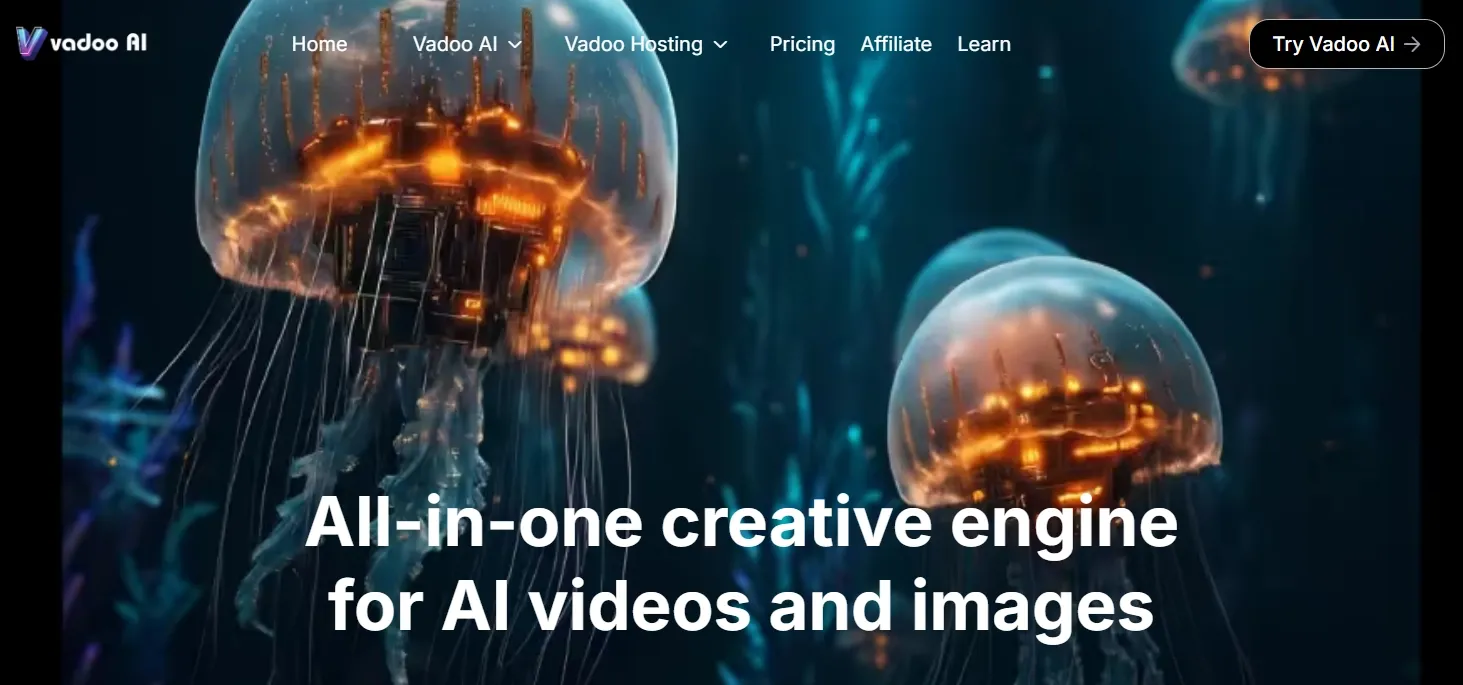
Vadoo AI is an AI video platform built around model access, AI video generation, and light post-creation tools. Instead of focusing on one narrow task, it lets you start from an idea or existing asset and move toward a short video inside one workspace.
The platform is mainly useful for creators, marketing teams, and small teams that need a faster way to produce social content. Its biggest appeal is creative range — but that range also makes the workflow feel less focused once the goal moves beyond casual experimentation.
What Other Users Say About Vadoo AI
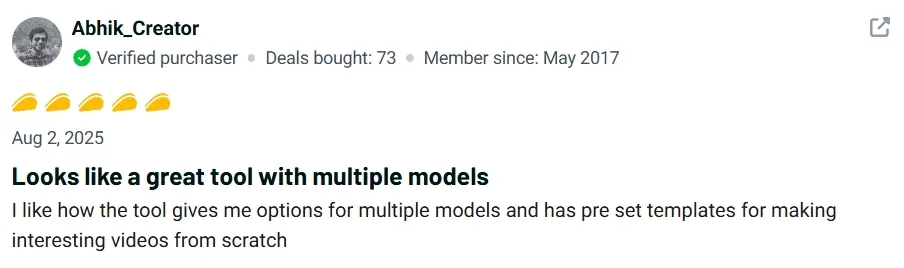
User feedback is mixed. The positive pattern is clear: users like the speed, the range of video templates, and the ability to create reels or ad drafts without starting from an empty timeline. On AppSumo, Vadoo AI shows a 4.0 rating across 166 reviews at the time I verified.
The critical pattern matters too. Some users mention confusing navigation, onboarding friction, unclear paid-tool behavior, and support concerns. On Trustpilot, Vadoo AI shows a much lower 1.9 rating, with recent complaints focused on credits, failed generations, cancellation, and support response.
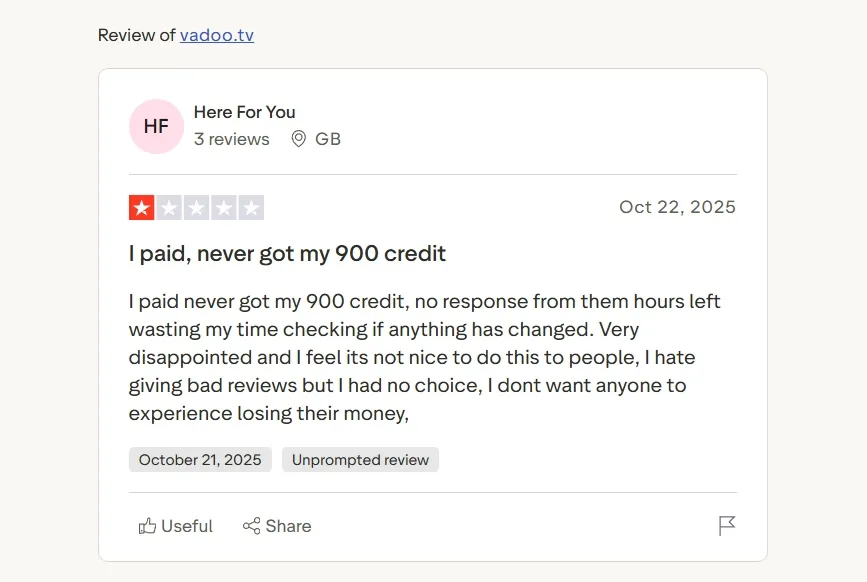
I would not treat reviews as the whole story, but I would treat them as a risk signal. If a tool is only for casual content experiments, friction is annoying. If it is for client work or paid campaigns, friction becomes expensive.
Key Features I Reviewed
Multi-Model Integration Hub
The multi-model hub is Vadoo AI’s strongest idea. Bringing several AI video models such as Hailuo AI and Kling AI into one workspace makes exploration faster because you are not locked into a single visual engine.
That range helps when a story video needs a specific mood. A dramatic scene, a playful short, and a realistic product moment often need different model behavior, so having model choice in one place is genuinely useful.
When the creative direction was clear, the hub made comparison easier and gave me more room to test visual tone. It was the one area where Vadoo felt most competitive.
Text to Video
Text to video is the simplest entry point. It turns written ideas, prompts, or scripts into video drafts when you have a message but no footage.
It works best for short explainers with a clear problem, explanation, and takeaway. For simple educational clips, it gives creators a fast way to turn text into something watchable.
It helped me start, but it did not make the video feel intentionally built. Pacing can feel flat, visuals can feel generic, and the hook usually needs manual improvement. The output regularly feels like a draft rather than a finished video.
Image to Video
Vadoo’s image-to-video tools animate static visuals with motion and atmosphere. I found them useful when the starting image already had a clear purpose in the video.
For product videos, this can make a product asset feel more active in a feed. A still product shot becomes more usable when motion adds attention without losing the original visual identity.
The catch is that the user still has to supply the reason the viewer should care. The motion can look decorative instead of meaningful — it can make an image move, but it does not reliably turn that image into a persuasive product moment.
Video to Video Stylization
Video-to-video stylization starts from footage that already has motion. Instead of building a scene from scratch, Vadoo AI can restyle existing material into a different look.
This works well for anime-style clips or creator series where the style is part of the identity. The original footage provides structure while stylization changes the visual language.
The weakness is consistency. When the style shifts too much between clips, the content starts feeling like random experiments instead of a recognizable format. Stylized outputs look fun in isolation, but they are harder to trust across a series.
AI Video Effects
The effects library is built for quick social attention. These transformations can make the first second more surprising, which helps when creating trendy content for fast-scrolling platforms.
For a viral video, that first visual beat can help stop the scroll. Vadoo AI’s effects are useful when the creator already has a trend, reveal, or punchline in mind. Without a strong concept, the effects can feel shallow.
AI Audio Suite
The audio suite adds voiceovers and lip syncing, which makes Vadoo AI more useful than a silent visual generator. Audio gives short videos a clearer path for narration, timing, and viewer attention.
A voiceover can carry the message while visuals and subtitles support the pace. For faceless creator content, this is helpful.
Still, the audio layer is not polished enough to carry weak content. Some voice-driven outputs can feel mechanical, and lip syncing does not automatically make a presenter feel natural. The feature helps, but it does not remove the need for script quality and delivery judgment.
Editing and Social Formatting Tools
The precision tools are meant to fix or adjust generated visuals after the initial output. They are useful when a clip is close but needs changes in appearance, framing, or visual fit.
For branding videos, that can matter. A small visual mismatch can make a draft look off-brand, and adjustment tools can prevent users from restarting the whole generation.
They can correct details, but they do not solve bigger problems like weak pacing, unclear structure, or disconnected scenes. For production work, that is a real limitation — these tools feel more like patches than a strong editing workflow.
Vadoo’s social media optimization helps prepare videos for quick-format platforms. For Instagram story ads and other vertical formats, thinking in the right aspect ratio and pacing from the start is useful.
Pros and Cons
What I Liked
- Broad model access for testing different visual directions
- Fast drafts from text, images, or existing footage
- Useful audio tools for faceless and character videos
- Social format support helps creators move faster
What Held It Back
- Workflow feels scattered for polished production
- Stylized outputs lack reliable consistency
- Effects feel shallow without strong concepts
- Editing tools only fix surface problems
- User feedback raises concerns around credits, navigation, and support
Create Full Videos with Van Gogh Studio Free
Where Vadoo AI Falls Short
Vadoo AI works when I treat it as a creative exploration tool. It can generate drafts, test styles, add audio, and prepare short clips for social platforms.
The limits show up once the goal is a finished video:
- Fragments over finished output — the platform creates pieces of a video more easily than a complete one
- Structure still falls on you — hook, pacing, scene order, and final polish need manual work
- Consistency across a series — stylized clips can look fun alone but drift from clip to clip
- Reliability risk signals — credits, navigation, and support complaints make it harder to trust for client or campaign work
Once the work needs to become production-ready, the workflow feels much weaker.
Real Use Cases
| Use Case | How Vadoo AI Fits |
|---|---|
| Social video creation | Helps test short clip ideas quickly, especially for Instagram-style feed pacing |
| Product visual animation | Animates static product assets so early product video concepts start faster |
| Stylized creator content | Restyles existing footage when the motion already works and you need a stronger look |
| Faceless narration videos | Audio tools, captions, and visuals support AI faceless workflows without filming |
| Early ad concept testing | Helps marketing teams rough out ad angles before spending budget on short ad generation |
Vadoo AI vs Van Gogh Studio
| Dimension | Vadoo AI | Van Gogh Studio |
|---|---|---|
| Creative exploration | Broad toolset for fast experiments | Clearer workflows for turning ideas into complete videos |
| Model access | Useful multi-model hub | Top-tier video models such as Seedance and Veo |
| Social clips | Useful for short drafts and stylized formats | Stronger when creators need consistent, repeatable publishing |
| Marketing videos | Useful for rough ad concepts | Marketing Studio is built around campaign-ready video workflows |
| Human presence | Supports AI audio and lip syncing | AI avatar creates talking-avatar videos from one photo |
| AI video editing | Surface-level visual adjustment tools | AI video editor edits with text prompts — styles, objects, backgrounds, and scenes |
| Finished output | Often still needs user assembly and review | Van Gogh Studio Agent helps generate post-ready videos with structure and pacing |
| Best fit | Creators exploring styles and short drafts | Creators and marketers who need publish-ready AI videos |
Why Van Gogh Studio Feels Like the Better Vadoo AI Alternative
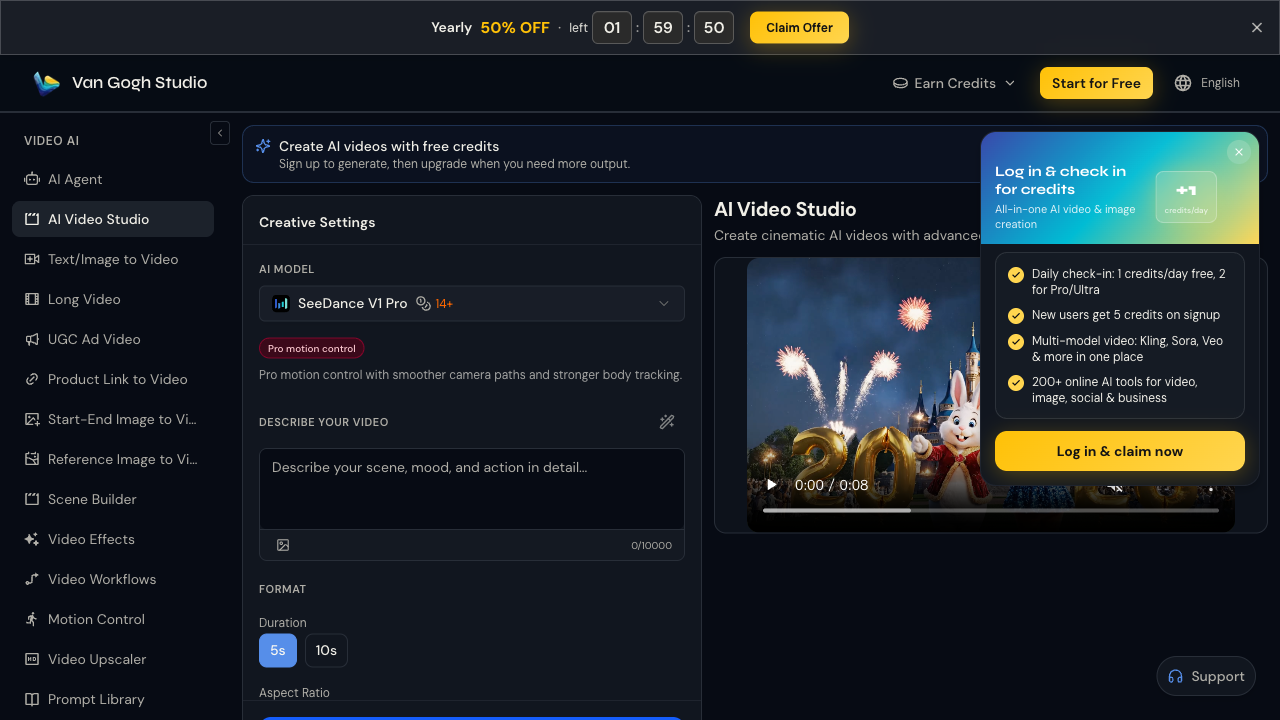
Stronger Access to Leading Video Models
Van Gogh Studio gives creators fast access to multiple industry-leading video models, so you can test the newest generation styles and capabilities in one place.
Seedance 2.5 is strong for multimodal references, visual consistency, and realistic motion. Veo 3.1 works well for controlled product, brand, and cinematic videos. Kling 3.0 is useful for character motion, action-heavy clips, and multi-shot storytelling.
With Van Gogh Studio, you can choose the right model for the task instead of forcing every idea through one model.
Van Gogh Studio Agent Helps You Finish the Video
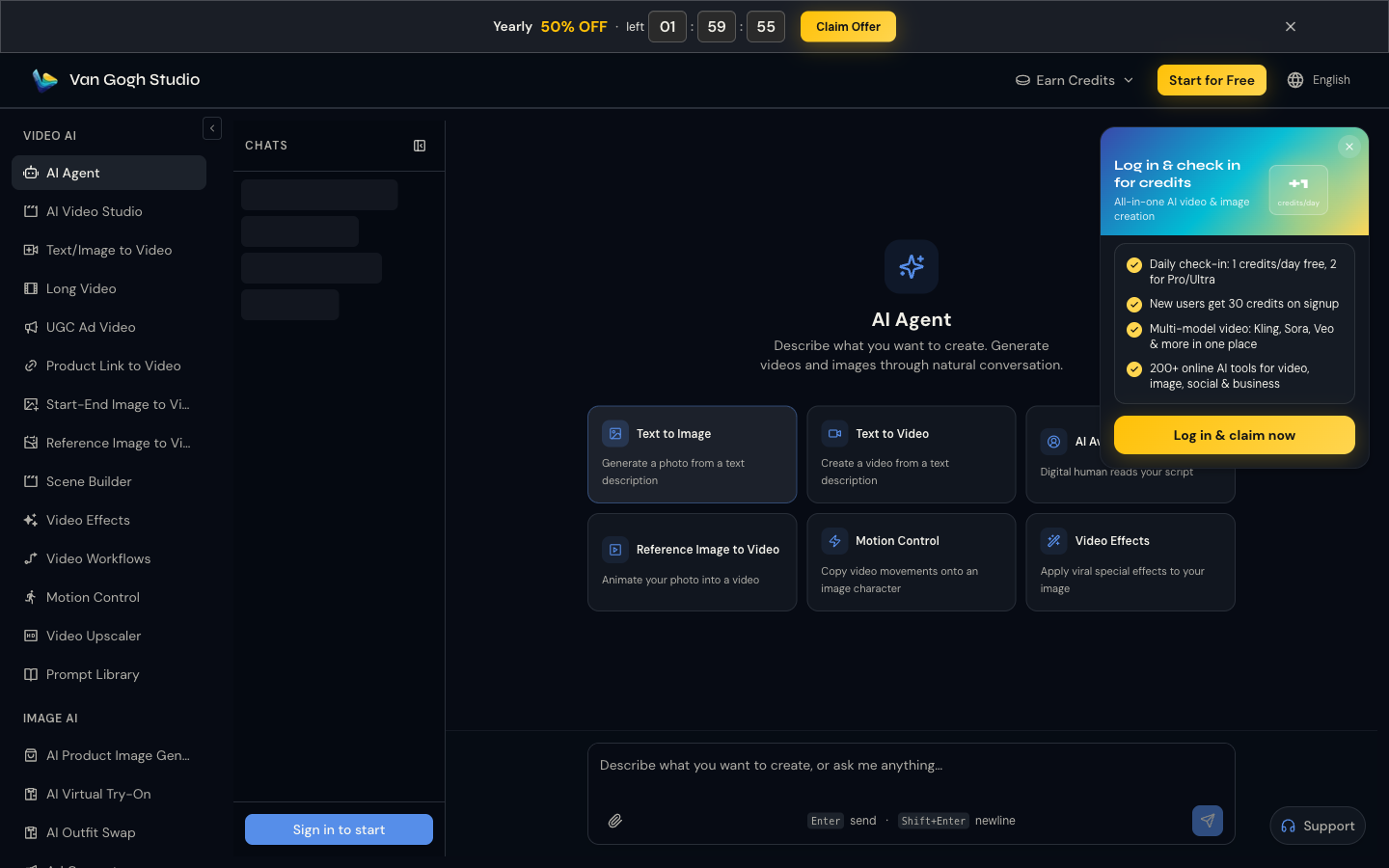
The biggest practical advantage is Van Gogh Studio Agent. Vadoo AI gives users many ingredients, but the user still has to connect them into a finished video.
Van Gogh Studio Agent is built for that missing step. It can turn an idea, URL, image, or asset into a post-ready video while handling structure, pacing, music, captions, and the opening hook with less manual editing.
That matters because production time is often lost between draft and final. Van Gogh Studio Agent reduces that gap, which makes it more useful for creators and teams that need ready-to-use videos regularly.
Create Videos with Van Gogh Studio Agent
Marketing Studio Is Better for Marketers
For marketing teams, Marketing Studio by Van Gogh Studio is the stronger workflow because it is built around ad production, not just visual generation.
A marketer can start from a product URL, a script, or an ad idea and move toward structured video ads such as TVC ads and comparison UGC ads, without coordinating a shoot or building each scene manually.
Teams can also test more concepts before paying for creators, agencies, or reshoots. The workflow is built around hooks, product context, and viewer action — which matters more than visual novelty alone.
AI Avatar Adds Human Presence Without Filming
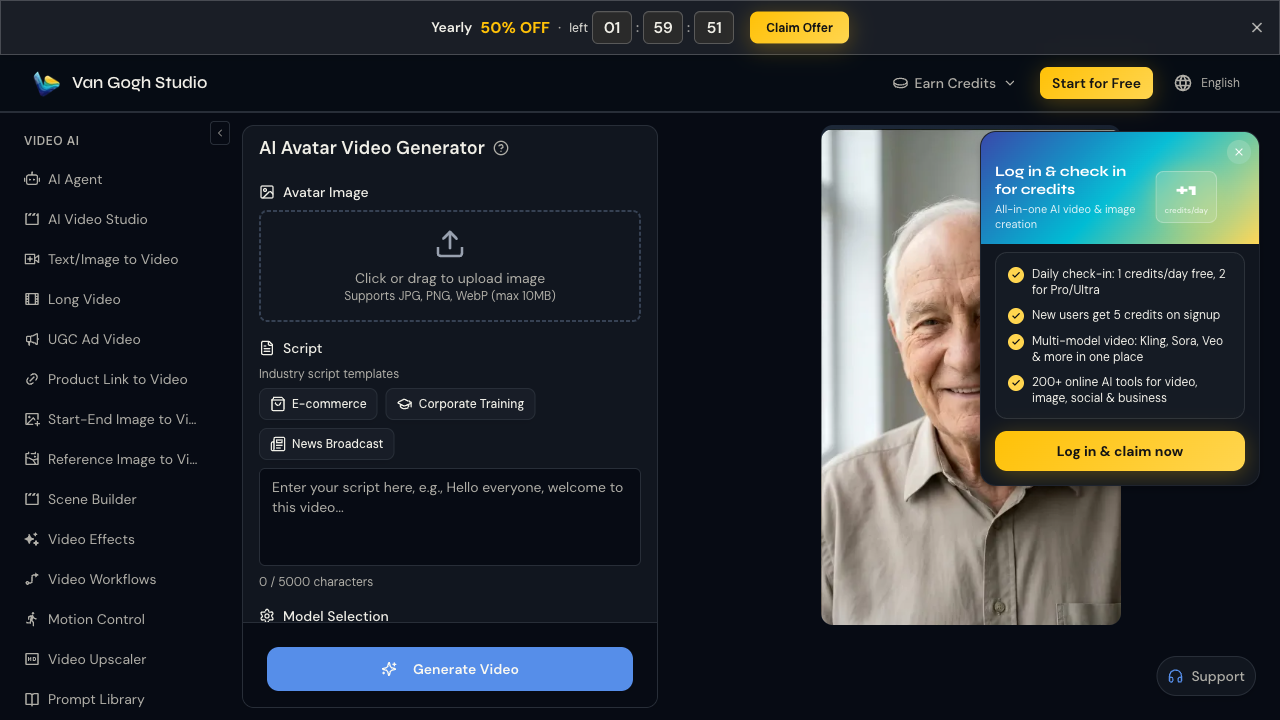
Van Gogh Studio Avatar also stood out after reviewing Vadoo AI’s audio and lip-sync workflow. Vadoo AI helps with voice and sync, but avatar creation gives users a more direct route to presenter-style content.
Van Gogh Studio Avatar transforms a single photo into a talking avatar with lip sync, facial expressions, and gestures. This removes the need for filming, pre-recorded clips, or extensive training.
For product explainers, tutorials, and brand messages, that human presence can make the content feel clearer and more trustworthy while keeping production fast.
Final Verdict
Vadoo AI is useful for quick drafts, model exploration, effects, audio, and social video experiments.
After testing it for 2 weeks, I found it much weaker as a production workflow. The platform feels broad but loose, and several features still leave too much finishing work to the user.
Van Gogh Studio is stronger for creators and marketing teams who need videos that come out closer to share-ready. It offers industry-leading video models, Van Gogh Studio Agent for post-ready videos, Marketing Studio for campaign videos, and AI Avatar for presenter-style content without filming.
Vadoo AI Review FAQs
Is Vadoo AI good for beginners?
Yes for exploration. Beginners can get short drafts and stylized clips quickly. It is less ideal if you need a guided path all the way to a polished, publish-ready video.
What is Vadoo AI best for?
Short social drafts, visual experiments, multi-model testing, and early ad concepts. It is better at generating pieces of a video than shipping finished campaigns.
What is the biggest drawback of Vadoo AI?
For me, the biggest drawback is that the workflow creates fragments more easily than finished videos. Structure, pacing, consistency, and final polish still fall largely on the user.
What is the best Vadoo AI alternative?
If you want multi-model generation plus a clearer path to finished output, Van Gogh Studio is the better alternative. It covers Agent-led publish-ready videos, marketing workflows, AI avatar, and AI video editing in one workspace.
Create AI videos free
Try Van Gogh Studio free — text-to-video, image-to-video, and 300+ models in one place. Free credits on signup, no credit card required.
Try Free Video Generator