OpenAI’s Sora 2 is one of the most talked-about AI video models of this cycle: synchronized audio, stronger physical realism, and multi-shot sequences that stay more coherent than the first Sora wave. I tested it with complex prompts — underwater physics, zero-gravity chaos, and a rain-soaked chase — to see what holds up for real creative work.
Alongside the model, OpenAI’s Sora app pushed a social loop: create, remix, browse a feed, and use Cameo-style likeness features. That packaging matters for virality. For production, what matters more is whether the model follows your brief and whether you can finish the video afterward.
Quick Verdict
Sora 2 is elite for cinematic, physics-heavy clips with native audio. Access, length limits, and finishing still decide whether it fits your workflow. For day-to-day production with multiple models side by side, I use Van Gogh Studio.
| Review point | My take |
|---|---|
| Best for | Cinematic motion, synced audio, multi-shot story beats |
| Not best for | Guaranteed always-on access, unlimited length, full ad assembly |
| Biggest strength | Physical realism + audio that lands with the action |
| Biggest weakness | Availability / workflow friction vs multi-model studios |
| Score | 8.6 / 10 for wow + realism; 7.2 / 10 for everyday shipping |
| Practical workspace | Van Gogh Studio |
What Is Sora 2?
Sora 2 is OpenAI’s next-generation text-to-video (and broader video) model. Compared with the original Sora, it focuses harder on:
- Physical realism — gravity, buoyancy, collisions, water, debris
- Synchronized audio — voices, ambience, and score timed to the scene
- Consistency — characters, wardrobe, and world state across multi-shot prompts
It sits in the same “front-rank closed model” conversation as Veo and other premium engines. The right question is not “Is it impressive?” — it is — but “When should you use it versus another model?”
Why Sora 2 Stood Out in Testing
Unlike older generators that approximate motion, Sora 2 often feels like it simulates constraints. Objects splash, float, and collide in ways that read as physical rather than decorative. Audio is not a bolted-on afterthought in the best takes; it lands with the visual beat.
That combination is why Sora 2 excels at:
- Action and chase sequences with environmental interaction
- Atmospheric scenes where sound sells immersion
- Multi-shot prompts that need the same character to survive a cut
Hands-On Prompt Tests
I did not only run one-liners. I used multi-shot prompts that stress physics, audio, and consistency together.
1. Underwater crystal cave
Prompt: A deep-sea diver discovers a hidden underwater crystal cave. Shot 1: wide angle of diver swimming through dark water with a flashlight beam. Shot 2: close-up of the diver’s face as crystals begin glowing. Shot 3: pull back revealing a cavern with bioluminescent jellyfish. Include underwater breathing sounds, crystal chimes, and ethereal ambient music. Bubbles rise realistically; light bends through water.
Output notes: Bubble trajectories and light falloff looked convincing. Breathing and muffled ambience sold the environment. Diver gear stayed reasonably consistent across shots — the exact failure mode where many models break.
2. Zero-gravity station emergency
Prompt: Emergency on a space station. Shot 1: astronaut floating calmly when red warning lights flash. Shot 2: tools and objects drift as artificial gravity fails. Shot 3: astronaut pushes off walls through debris toward an emergency panel. Include alarms, metallic clangs, helmet breathing, and a tense score.
Output notes: Debris motion and contact timing were the highlight. Audio matched impacts better than most competitors I have used for space scenes. Suit details held up while the camera tumbled.
3. Tokyo rain motorcycle chase
Prompt: Motorcycle chase through neon-lit Tokyo in heavy rain. Shot 1: low angle as the bike hits a puddle. Shot 2: tracking shot weaving between cars with horizontal rain streaking. Shot 3: aerial skid around a corner leaving wet tire tracks. Include engine roar, rain, horns, splashes, and pulsing electronic music.
Output notes: Water physics and wet-road friction read clearly. Engine and splash sync were tight. Rider jacket/helmet/bike identity stayed stable enough for a short action beat.
Pros and Cons
| Pros | Cons |
|---|---|
| Excellent physics and environmental interaction | Access and quotas can be restrictive |
| Native audio sync that elevates immersion | Not a full editor or ad assembler by itself |
| Strong multi-shot character/world consistency | Complex brand/product control still needs review |
| High “first watch” cinematic quality | Length and commercial workflow vary by access path |
| Social remix culture via the Sora app | Everyday shipping often needs a broader studio |
Performance by Use Case
| Use case | Performance | Where it helps | Where it struggles |
|---|---|---|---|
| Cinematic B-roll | Excellent | Mood, camera, atmosphere | Exact brand props |
| Action / physics scenes | Excellent | Water, debris, vehicles | Overpacked constraints |
| Multi-shot storytelling | Strong | World continuity | Very long narratives |
| Marketing ads | Mixed | Hero visuals | CTA, offer, assembly |
| Product accuracy | Mixed | Stylish motion | Precise SKU fidelity |
| Daily social volume | Mixed | Standout clips | Throughput + access |
Where Sora 2 Still Falls Short
Access is part of the product. A great model you cannot reliably schedule around is a planning risk. Always have a backup model for deadlines.
It generates clips, not campaigns. You still need messaging, captions, offer structure, and sometimes alternate angles. That is normal — just do not confuse demo wow with finished ads.
Overpacked prompts can collapse. When I stacked too many simultaneous constraints, adherence dipped. Split complex stories into clearer shots.
Why Use Sora 2 (and Other Models) on Van Gogh Studio
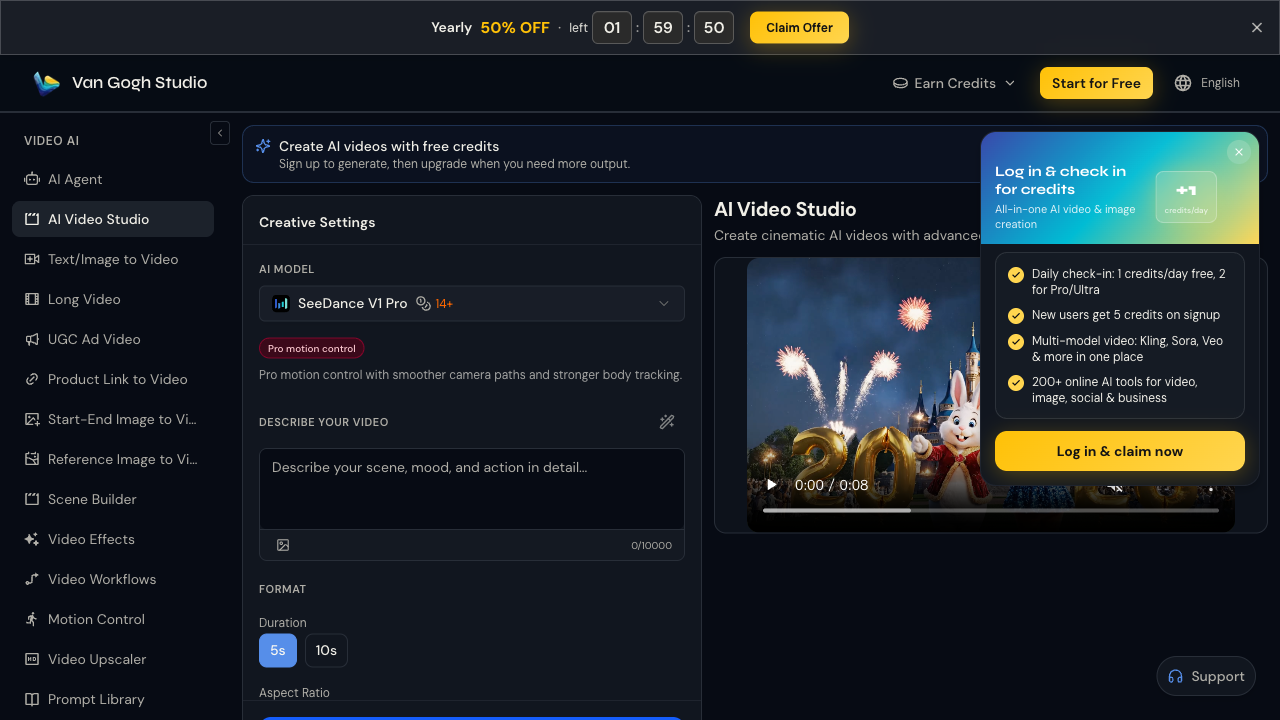
Van Gogh Studio is not a Sora-only sandbox. It is a production workspace where you can run leading models — including Sora, Veo, Kling, and more — then move into finishing paths:
- Generate in AI Video Studio or text / image to video
- Compare a Sora-class take against Kling or Veo on the same brief
- Finish ads in UGC ad video or structure the full piece with Agent
- Add video effects when you need trend formats fast
That workflow matters more than any single model win. Sora 2 can deliver the hero shot; Van Gogh Studio helps you ship the video.
Try Van Gogh Studio to generate and finish without juggling disconnected tools.
Final Verdict
Sora 2 raises the bar for physics-aware, audio-synced AI video. My multi-shot tests were genuinely impressive — especially underwater light, debris motion, and rain interaction.
I would not treat it as the only tool in the kit. Access, finishing, and model diversity still decide shipping speed. For creators and marketers, the practical move is to use Sora-class quality when you can get it, and keep a multi-model studio like Van Gogh Studio as the daily production layer.
FAQs
Is Sora 2 better than the original Sora?
For motion realism, audio sync, and multi-shot consistency, yes — Sora 2 is a clear step up from the first generation.
Does Sora 2 generate audio?
Yes. One of its biggest strengths is generating visuals and audio together so timing feels native rather than dubbed.
Can I use Sora 2 for marketing videos?
You can generate strong hero clips. For full ads with offer structure and UGC pacing, finish in a workflow like UGC ad video or Agent.
Sora 2 vs Veo — which should I pick?
It depends on the brief and access. I recommend generating the same prompt on both when the spot is commercial-critical, then picking the cleaner take.
Where should I create if I need multiple models?
Use Van Gogh Studio so you can compare Sora-class outputs with Kling, Veo, Seedance, and other engines without separate accounts.
Create AI videos free
Try Van Gogh Studio free — text-to-video, image-to-video, and 300+ models in one place. Free credits on signup, no credit card required.
Try Free Video Generator