The negative prompt function in Kling AI for Text-to-Video and Image-to-Video enables you to indicate the kinds of content you wish to exclude from your videos.
However, overusing or misusing negative prompts can limit the creative potential of your videos. To create the top out of this feature, it’s essential to understand the best negative prompts for Kling AI and approaches to use them.
Thus, before starting your projects, follow our guide to learn the general negative prompts in Kling AI. Better even so, we’ll walk you through the best practices for writing them in Kling AI.
At a Glance
Negative prompts in Kling AI help you exclude blur, deformities, watermark junk, and other artifacts — if you use them carefully. Overloading them can flatten creativity.
| Point | Take |
|---|---|
| Best for | Cleaning Kling text-to-video and image-to-video outputs |
| Not best for | Replacing a strong positive prompt or full creative direction |
| Score | N/A (technique guide) |
| Try it on | Van Gogh Studio with Kling |
Best Practices for Writing Negative Prompts in Kling AI
To apply negative prompts effectively, here are some best practices to follow
- What’s top important is that you don't demand to add negative words to the elements you want to avoid, as the negative prompts field in Kling AI automatically recognizes what you're typing as something you don't want.
- For visual quality, type “low resolution,” “blurry,” or “dark tone” to detail your requirements rather than the unclear phrase - “low quality.”
- For scenes, enter “dogs” rather than “animals” to be specific about which kind of animal you don't want to appear in the scene. Type “robots” rather than “no robots.” as Kling AI understands what you input is the element you don't demand.
Best Negative Prompts for Kling AI
Here, we’ve summarized the best negative prompts you generally want to use in Kling AI for video creation in multiple categories. These negative prompts are versatile across all video generations and are beneficial for getting results beyond expectations.
Visual Effects
These negative prompts illustrate the visual effect of a video, including picture quality, composition, color, and lighting.
Below are examples of negative prompts for every type:
- Picture quality: low clarity, low resolution, low quality, blurriness.
- Composition: no photographic techniques, unbalanced layout, complex composition.
- Color: mixed overall color style, dark tone, no white balance, overly dark colors, overly vibrant colors.
- Lighting: harsh shadows, hard lighting, ambient lighting, much shadow, morning light, sunset, artificial light.
Scenes
The negative prompts are used to avoid the generated video containing the scenes you don’t want, such as foreground, background, weather, and seasons.
Examples: indoor scenes, outdoor scenes, background, rainy, cloudy, autumn, dark sky, animals, and buildings.
Subjects
These prompts emphasize the focus of the video and avoid unnecessary objects. It can be an animal, baby, woman, man, student, object, plant, robot, etc.
Examples: weapons, electronic devices, insects, rivers, and people.
Emotions
Negative prompts to define the video tones for a specific purpose.
Examples: sad tones, excited tones, angry tones, and bad atmosphere.
Why Should You Use Negative Prompts in Kling AI?
To put it simply, using negative prompts in Kling AI helps you define the content or elements you do not want to appear in generated videos, such as blur, distortion, low quality, grainy, collage, etc.
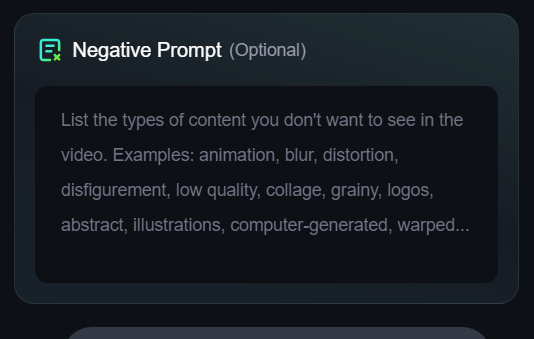
To create it in detail, using negative prompts can:
- Improve content relevance. By specifying what not to include, you can direct the AI to focus on the elements that are top important to your project, making the final output extra relevant and on-target.
- Bring enhanced creativity. Negative prompts allow the AI to avoid overused or irrelevant themes, helping it think outside the box and produce unique content that better fits your vision.
- Improve perform efficiency. The negative prompts reduce the description for excluding the unwanted content in the Prompt field and avoid modification after video generation.
Overall, using negative prompts is key to achieving greater precise, controlled, and high-quality AI-generated videos.
Use Kling AI Negative Prompts on Van Gogh Studio
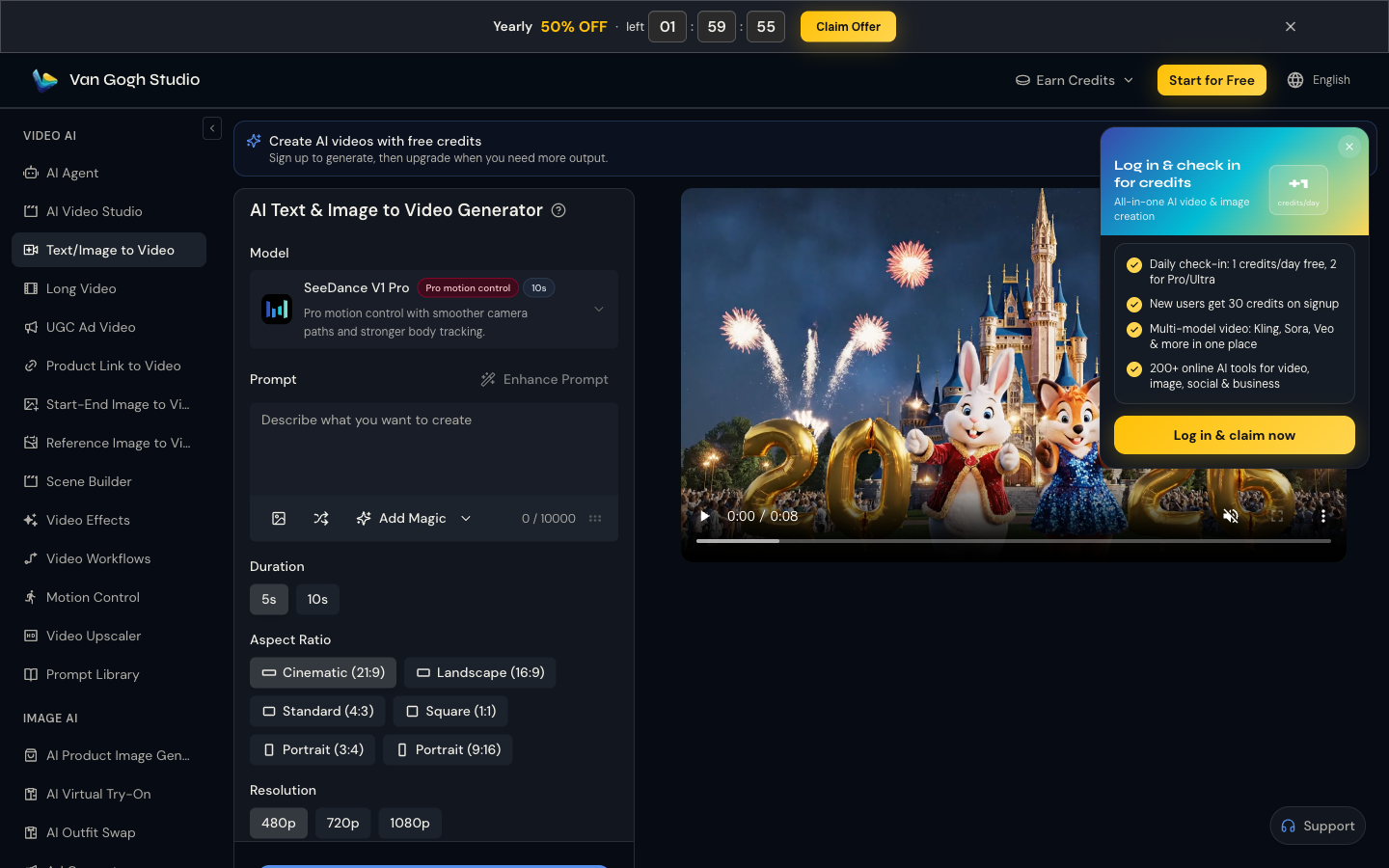
Want Kling’s negative-prompt control without bouncing between apps? Van Gogh Studio puts Kling AI next to other top video models in one workspace—so you can write a prompt, add exclusions, and generate from Text to Video or Image to Video.
Step-by-step
- Open Text/Image to Video (or start from the home create bar).
- Select a Kling model from the model picker.
- Write your positive prompt (subject, motion, camera, lighting).
- Add a negative prompt with the elements you want excluded—keep it specific (for example
blurry, low resolution, watermark, extra limbs, text overlay). - Set duration, aspect ratio, and resolution, then generate.
Negative prompts work best as a short exclusion list, not a second creative brief. Pair them with a clear positive prompt so Kling knows what to keep and what to drop.
Why run Kling here
- Multi-model access — compare Kling with Veo, Seedance 2.0, Wan, and more in one account
- Full video workflows — continue into Long Video, AI Video Studio, or polish with Video Upscaler
- Free credits to start — sign up and test Kling + negative prompts without a separate subscription
Conclusion
Use negative prompts in Kling AI to cut blur, wrong subjects, and off-mood tones—without stuffing “no …” into your main prompt. Keep exclusions specific, then generate on Van Gogh Studio with Kling AI so you can iterate faster and switch models when a clip needs a different look.
Create with Kling on Van Gogh Studio — free credits on signup.
Create AI videos free
Try Van Gogh Studio free — text-to-video, image-to-video, and 300+ models in one place. Free credits on signup, no credit card required.
Try Free Video Generator