I tested Flora AI to see whether its infinite-canvas creative workflow actually speeds up real image and video work — or mainly impresses designers who already think in node graphs.
In this Flora AI review, I’ll share what it does well, where video quality and learning curve hold it back, who it fits best, and why I would choose Van Gogh Studio when I need a clearer path from idea to publish-ready video.
Quick Verdict
Flora AI is a strong pick if your main goal is non-linear creative exploration on an infinite canvas: connect image, text, and video nodes, branch ideas, and keep every step visible. For designers who like spatial workflows, that mapping style is genuinely useful.
It is a weaker choice when you need reliable AI video quality, beginner-friendly generation, fast campaign output, or a finish path that feels practical every day. Flora’s image workflow is stronger than its video results. For a fuller production workflow, I prefer Van Gogh Studio.
| Review Point | My Take |
|---|---|
| Best for | Canvas-based creative exploration and image-led concept branching |
| Not best for | Reliable AI video, beginner workflows, or publish-ready campaign production |
| Strongest feature | Infinite canvas that connects image, text, and generation steps |
| Biggest limitation | Video quality and complex motion lag behind the canvas idea |
| Learning curve | Steep for beginners; better for experienced creative professionals |
| My verdict | Innovative canvas for concepting; limited as a practical video studio |
What Is Flora AI?
Flora AI (also known as Flora Fauna AI) is an AI creative platform built around an infinite canvas. Instead of a single generate box, you connect tools and generations like building blocks — images, text, and video steps stay visible in one spatial workspace.
Its biggest value is idea mapping. You can generate an image, describe it, create a variation, write ad copy, and branch into new visuals without losing earlier steps. Collaboration features such as commenting also support team feedback on the same canvas.
Compared with simpler AI video generators, Flora feels more like a creative whiteboard with models attached. It is less about shipping finished clips quickly and more about exploring connected creative paths.
Key Features I Reviewed
Flora’s feature set is organized around canvas exploration more than one-click publishing.
Infinite Canvas Workflow
The infinite canvas is Flora’s identity. Generations become nodes you can revisit, branch, and reconnect. That non-linear mapping helps when a project grows through iterations — brand concepts, campaign moodboards, or style experiments.
For experienced creatives, this can feel freeing. For beginners, the same interface can feel overwhelming because there is no single guided “make a video” path.
Image Generation and Variation Chains
Image generation was the strongest part of my testing. A detailed flower still looked rich and high-resolution. Chaining that still into a text description and then into a new style variation worked well for concept exploration.
In a luxury stilettos campaign test, Flora helped produce poster concepts, product copy, mockups, and model-led promotional images from connected steps. That campaign-material branching is where the canvas idea earns its keep.
Text and Multi-Model Support
Flora integrates multiple AI models for text and visual generation, which helps when you want description, copy, and image variation in one place. The connected workflow makes prompt refinement feel more like design process than isolated chat.
Quality still varies by request. Complex figure actions — such as awkward sword positions in a ninja variation — can miss the mark even when the canvas flow itself is elegant.
Video Generation on the Canvas
Video is available, but it was the weakest part of my review. A Halloween pumpkin clip looked textured and lit well, yet motion stayed basic and the smile did not animate the way I expected. A more complex Pixar-style mice scene captured prompt elements but moved robotically and struggled with natural interaction.
Video also felt expensive relative to the quality. Short clips can consume a large share of credits, which makes experimentation less practical.
Pros and Cons
What I Liked
- Infinite canvas keeps creative steps visible and reusable
- Strong for image-led concept branching and campaign moodboarding
- Connected text + image flows help refine ideas without switching apps
- Collaboration/commenting supports team creative review
- Generous starting credits make early testing approachable
What Held It Back
- Steep learning curve for beginners and casual users
- Video quality lags behind the canvas concept
- Complex motion and subject interaction can look robotic
- Generation can feel slow relative to simpler tools
- Video credit cost feels high for the output quality
- Not practical enough for everyday publish-ready video production
Create Full Videos with Van Gogh Studio Free
Where Flora AI Falls Short
Flora’s limits show up when the canvas needs to produce reliable finished video, not just connected concepts.
Canvas Innovation Does Not Equal Video Quality
Flora’s interface idea is distinctive. Video results did not match that ambition in my tests. Simple scenes were passable; complex character motion and environmental interaction broke down.
If the job is publish-ready AI video, a beautiful node graph is not enough.
Steep Learning Curve Blocks Everyday Use
Flora assumes comfort with spatial creative tools. Beginners who want a direct text-to-video or image-to-video path may spend more time learning the canvas than shipping content.
That makes Flora better for design professionals than for marketers who need fast, repeatable output.
Weak Fit for Campaign Finish Work
Performance ads, ecommerce creatives, UGC video ads, and social campaigns need hooks, product focus, pacing, captions, and channel-ready formats. Flora can help concept the visuals. Turning those concepts into finished video still feels incomplete.
Credit Cost Versus Video Value
When short video generations burn a large credit share for basic motion, experimentation becomes expensive. That undercuts the canvas advantage, because the whole point of branching ideas is to try more versions, not fewer.
How I Reviewed Flora AI
I reviewed Flora as a creative canvas platform with image and video generation — not as a single-purpose video model.
Main areas I considered:
- Canvas usefulness — whether non-linear mapping improved real creative work
- Image quality — whether connected generation chains produced usable stills
- Video quality — whether motion and scene interaction felt publishable
- Learning curve — whether beginners could reach useful results quickly
- Speed and cost — whether generation time and credits felt practical
- Use-case coverage — concepting, brand campaigns, social clips, ads, stories
- Business value — whether teams could finish work without leaving the canvas
Is Flora AI Right for You?
Flora is a strong fit if you like spatial creative tools and need to explore image-led concepts across connected steps. I would recommend it for designers, creative directors, and teams who moodboard campaigns, branch style directions, and keep iteration history visible.
It is also useful when collaboration on a shared creative map matters more than one-click generation. The canvas makes feedback and branching feel natural.
Flora is less ideal if you are a beginner, need reliable AI video, or want a fast path from brief to publish-ready clip. In those cases, a more direct AI video studio with stronger generation and finish tools is the better starting point.
In short: Flora is right for users who want to map creative ideas. It is less ideal for users who need to ship finished videos quickly.
Real Use Cases
| Use Case | My Take |
|---|---|
| Creative moodboarding | Strong fit — canvas branching keeps concept paths visible |
| Image-led campaign exploration | Strong fit for posters, copy, mockups, and style variations |
| Team creative collaboration | Good fit when comments and shared canvas review matter |
| Simple video experiments | Mixed fit — basic scenes can pass; motion stays limited |
| Complex character video | Weak fit — robotic motion and interaction issues show up |
| Product ads / UGC campaigns | Limited fit — concepting helps, finish path is weak |
| Beginner one-click video | Not the right tool; learning curve is too high |
Flora AI vs Van Gogh Studio
| Dimension | Flora AI | Van Gogh Studio |
|---|---|---|
| Main workflow | Infinite canvas for connected image/text/video exploration | Full AI video generation, editing, and publish-ready workflows |
| Image generation | Strong for concept chains and creative branching | Strong via AI image generator with a clearer video next step |
| Video generation | Available, but quality and motion consistency lag | Stronger text to video and image to video paths |
| Learning curve | Steeper canvas-first experience | More direct generation and production paths |
| Marketing output | Better for concepting than campaign finish | Stronger with UGC ad video and campaign-ready workflows |
| Editing flexibility | Canvas iteration more than post-production polish | Stronger follow-up refinement with the AI video editor |
| Best fit | Designers who think in spatial creative maps | Creators and marketers who need finished AI videos, not only concept graphs |
Why Van Gogh Studio Is a Better Flora AI Alternative
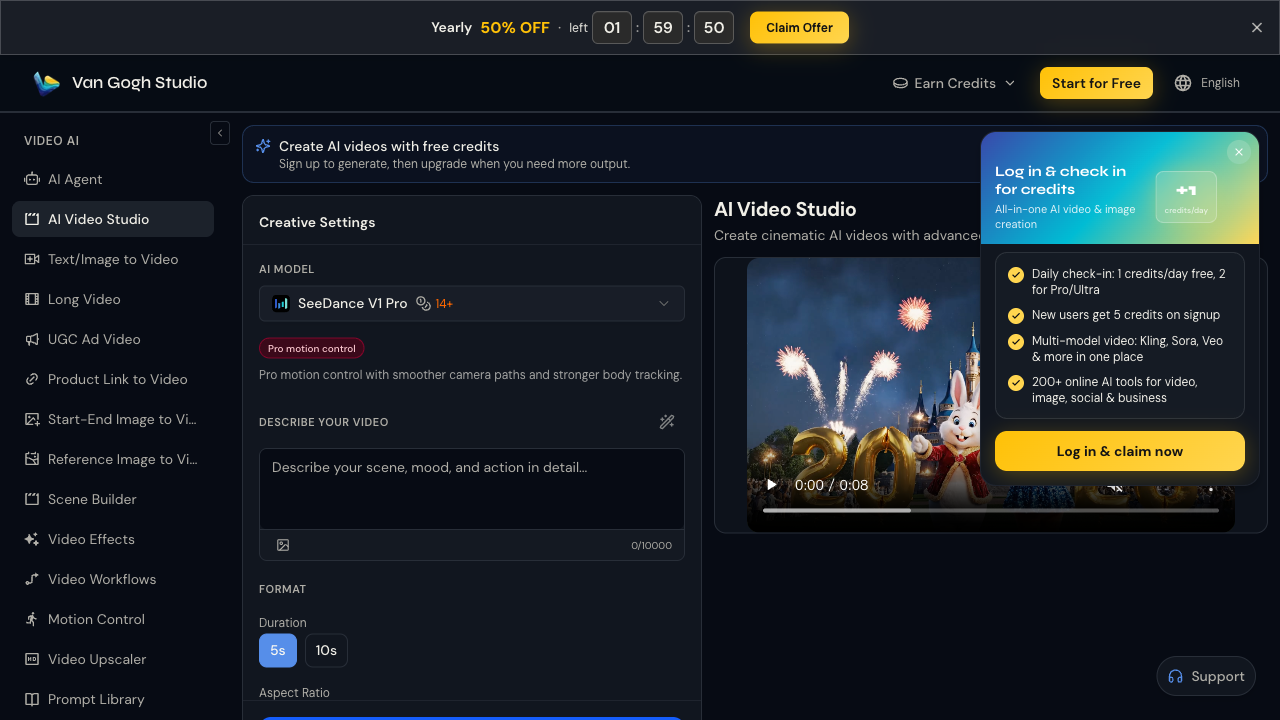
Flora is useful for canvas-based concepting. Van Gogh Studio is stronger when I need reliable generation and a clearer finish path for real publishing work.
Broader AI Video Generation With Less Canvas Overhead
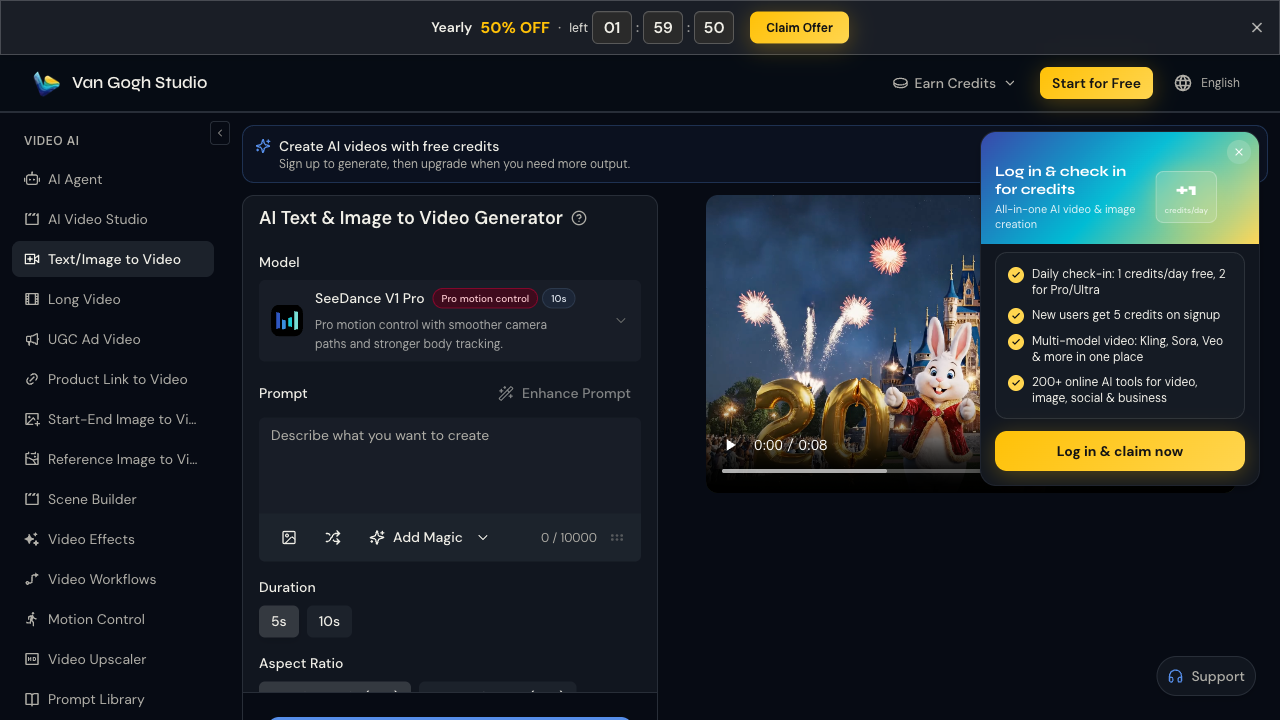
Van Gogh Studio gives me more direct starting points: text to video for concepting, image to video for product stills, and multi-model access when I want different motion styles. Models such as Veo 3.1, Kling 3.0, and Seedance 2.5 matter when one look is not enough.
That is the clearest gap versus Flora. Flora can map ideas spatially; Van Gogh Studio is better when those ideas need to become watchable video without fighting the interface.
Post-Ready Videos With Van Gogh Studio Agent
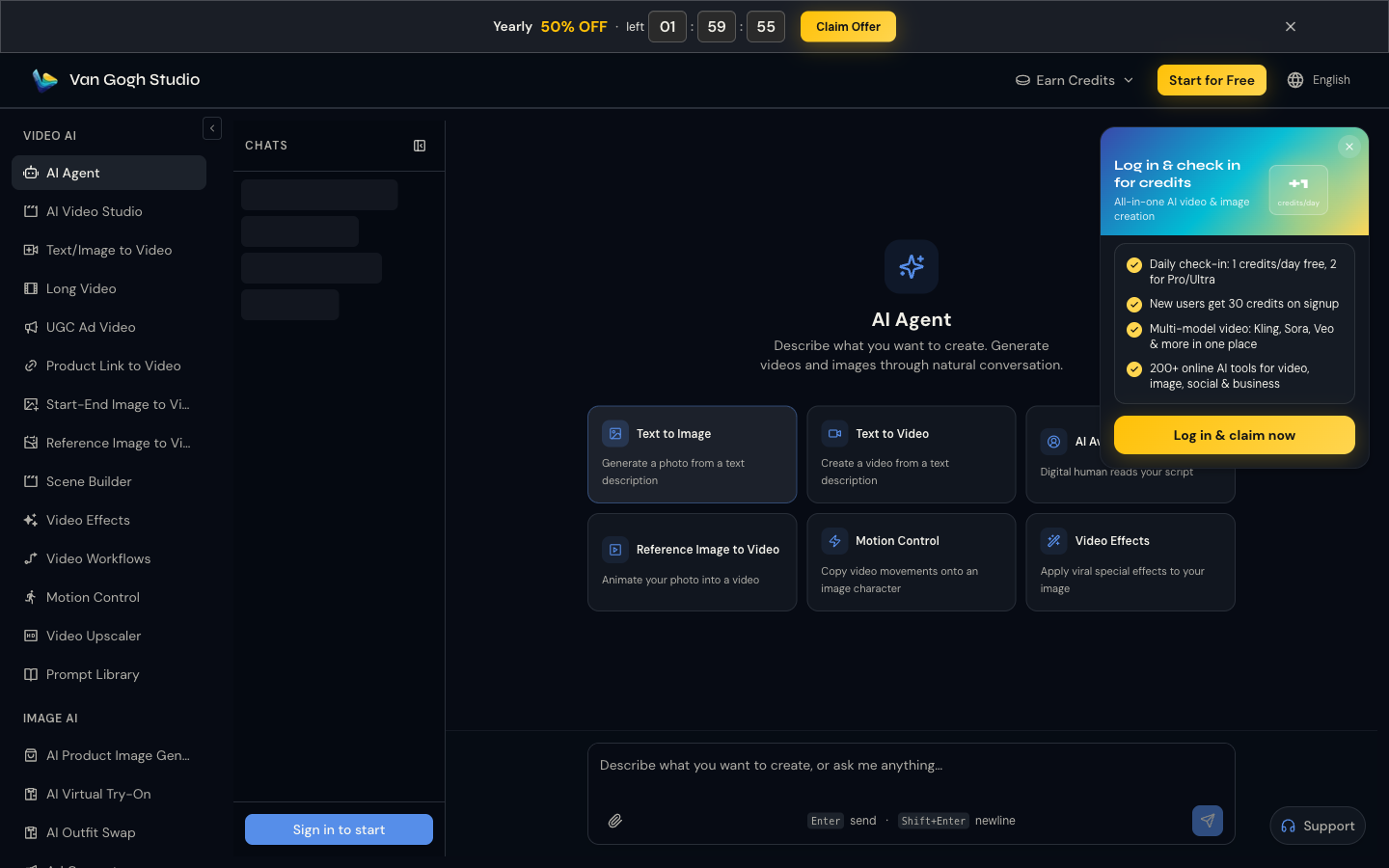
Van Gogh Studio Agent gives a stronger end-to-end production advantage. Instead of only branching concepts on a canvas, it is designed to create structured, production-ready videos with less manual assembly.
I can start from an idea, text, image, or URL, and the Agent can help handle structure, pacing, visuals, and sound. That makes it more suitable when I want a finished result instead of a creative map that still needs another tool.
Create Videos with Van Gogh Studio Agent
Image Plus Video Without Switching Mindsets
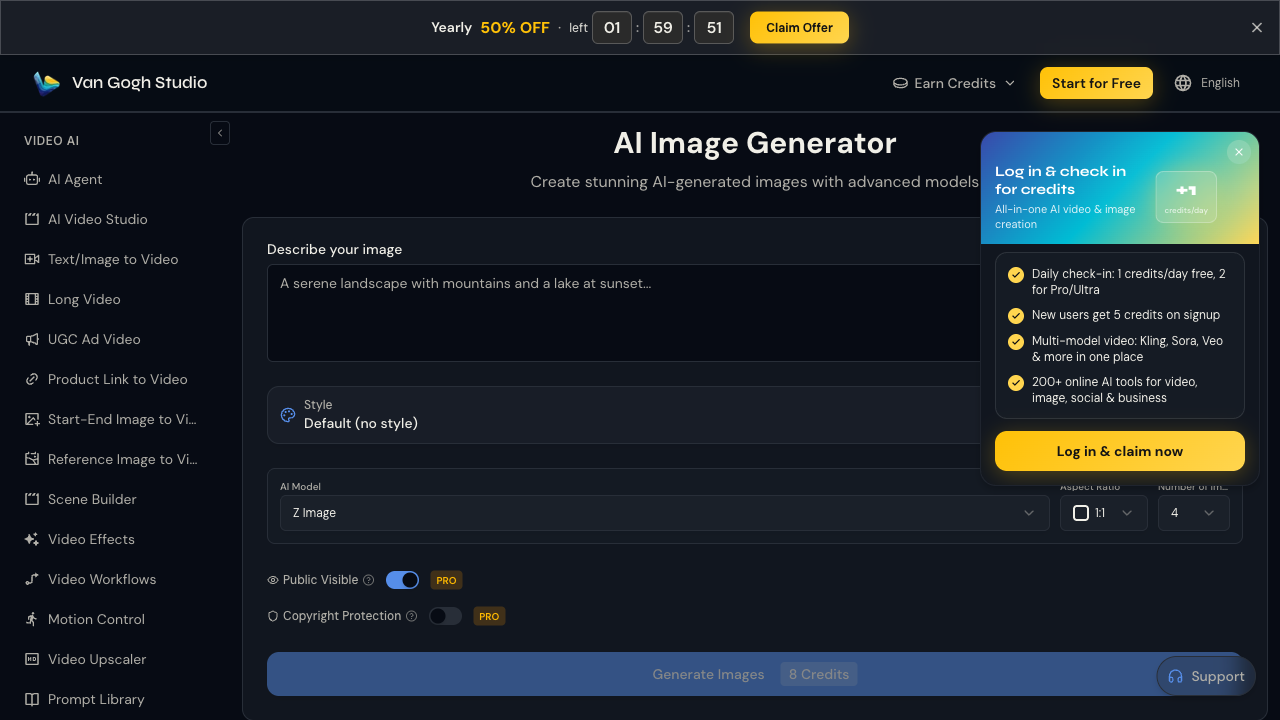
Flora’s image chains are useful. Van Gogh Studio’s AI image generator keeps still creation close to video, editing, and campaign tools — so concepting does not become a separate system from publishing.
Stronger Marketing and Commerce Workflows
For ads, launches, and product promos, I need hooks, variations, pacing, and channel-ready formats. Van Gogh Studio’s marketing and product-video workflows — including UGC ad video and link to video — are built for that campaign output, not just canvas moodboards.
Final Verdict: Is Flora AI Worth Using?
Flora AI is innovative and genuinely useful for image-led creative exploration on an infinite canvas. For designers who want connected concept branching, that workflow can feel unique.
Practical video production is the main issue. Flora is not a strong choice for reliable AI video, beginner-friendly generation, product ads, ecommerce visuals, UGC-style campaigns, or everyday publish-ready output.
Use Flora when spatial concepting is the job. For a broader AI video workflow, I would choose Van Gogh Studio. It combines multi-model video generation, image tools, editing, Agent-led publish-ready workflows, and campaign tools in one place — so creative exploration can continue into finished video.
Flora AI Review FAQs
Is Flora AI good for beginners?
Not as a first AI video tool. The infinite canvas is powerful for experienced creatives, but beginners may find the learning curve steep compared with direct generation workflows.
Is Flora AI better for images or videos?
Images. In my tests, image generation and concept chaining were stronger than video quality, motion consistency, and credit efficiency.
What is the biggest drawback of Flora AI?
For me, the biggest drawback is that the canvas idea outpaces video usefulness. If you need reliable motion and publish-ready clips, you will likely outgrow it.
What is the best Flora AI alternative?
If you want creative generation with a clearer finish path, Van Gogh Studio is the better alternative. It covers text to video, image to video, AI image generation, editing, UGC ads, and Agent-led publish-ready videos in one workspace.
Create AI videos free
Try Van Gogh Studio free — text-to-video, image-to-video, and 300+ models in one place. Free credits on signup, no credit card required.
Try Free Video Generator